Conflict Management Training | 100% HRDC Claimable
Tasks, schedules, and pressures that are different at work will always cause problems. Conflict that isn’t solved slows down decision-making, lowers output, and makes customers unhappy. This program gives teams and leaders useful tools to stop, calm down, and settle disagreements quickly and professionally, keeping relationships safe and business goals on track.
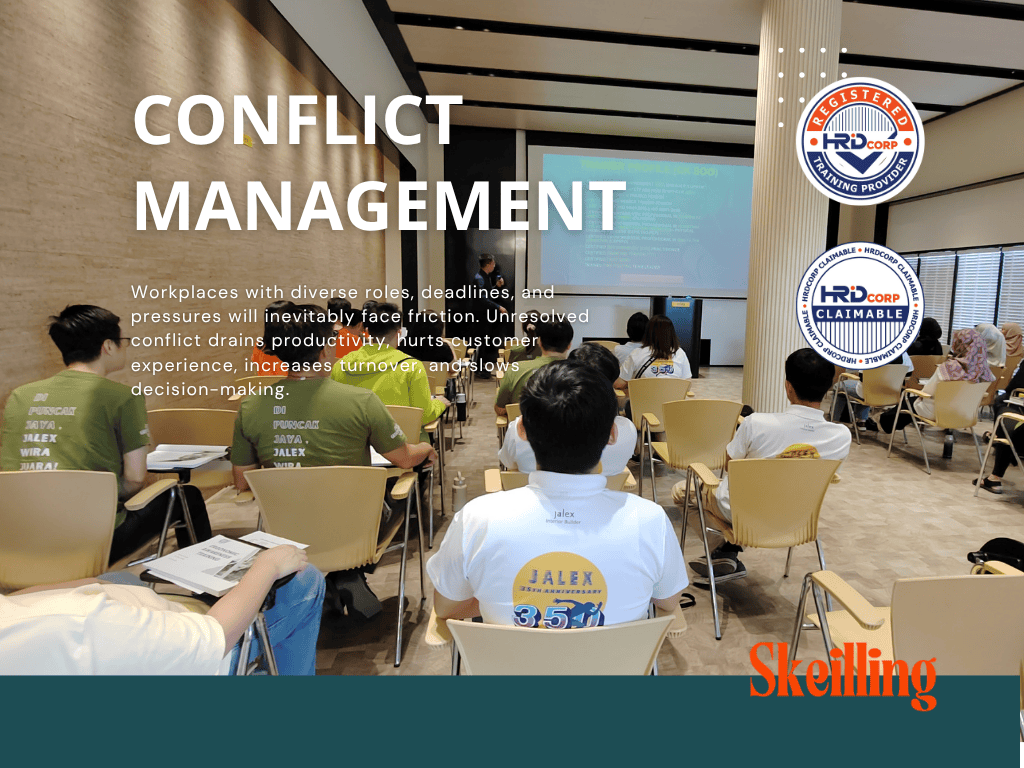
Conflict Management Training Objectives
- See early signs of disagreement and figure out what’s really going on (task, process, relationship, value).
- For fair results, use organized resolution models like the Interest-Based Relational Approach.
- To get people to stop being defensive and find common ground, use influence, understanding, and assertive communication.
- Lead tough talks, work out agreements that are good for everyone, and write down things that need to be done.
- Set team norms (roles, SLAs, feedback cycles, and escalation tracks) to stop problems from happening again.
SBL-Khas Scheme (Skim Bantuan Latihan Khas) / HRD Corp Claimable Course A direct claim scheme where HRD Corp pays the training provider directly using the employer’s levy balance. SBL Scheme (Skim Bantuan Latihan) A reimbursement scheme where the employer pays first and claims back later from HRD Corp.
HRC Corp's Reminder SBL KHAS ! The Best
Conflict Management Learning Outcomes
People who take part will be able to:
- Separate views from interests, and change the focus from blaming to fixing problems.
- Set clear steps and deadlines for any one-on-one or group conflict talk.
- To ease the stress, ask questions, actively listen, and pay attention to body language.
- Pick the right style for the situation, such as fighting, working together, compromising, avoiding, or accommodating.
- Write up deals (RACI, working agreements) and keep track of what’s being done.
Who Should Attend this Conflict Management & Why
Team leaders and those in charge should focus on reducing day-to-day problems, maintaining project momentum, and supporting fair performance management.
Managers/HODs and project managers: Line up cross-functional partners and stop problems from getting worse, which can be expensive.
Customer-Facing Roles (Sales, Operations, and Support): Use tense situations to improve service and build trust.
HR, People Managers, and Internal Trainers: Help settle disagreements, train managers, and make the company’s culture stronger.
Aspiring Leaders: Learn how to handle tough talks early in their careers with more confidence.
2-Day Programme Conflict Management (9:00 AM – 5:00 PM)
Day 1 — Foundations & Tools
- 09:00–09:30 Welcome, goals, baseline assessment
- 09:30–10:45 Types & sources of workplace conflict; cost of unresolved issues
- 10:45–11:00 Break
- 11:00–12:30 Conflict styles (Thomas-Kilmann): strengths, risks, when to use
- 12:30–14:00 Lunch
- 14:00–15:30 Communication skills lab: listening, reframing, curiosity, CALM/LEAPS models
- 15:30–15:45 Break
- 15:45–17:00 Emotions & triggers: de-escalation, cognitive bias, saving face in Asian contexts
Day 2 — Practice, Facilitation & Agreements
- 09:00–10:30 Interest-Based Problem Solving: uncover interests, options, criteria
- 10:30–10:45 Break
- 10:45–12:30 Tough conversations playbook: setting agenda, boundaries, consequences
- 12:30–14:00 Lunch
- 14:00–15:15 Multi-party & cross-department conflicts: mediation basics, power imbalance
- 15:15–15:30 Break
- 15:30–16:30 Documentation that sticks: RACI, working agreements, action trackers
- 16:30–17:00 Personal action plans, ROI measures, next-90-day commitments
(Includes Malaysian case studies, role-plays, and templates. Recommended class size: 10–36 pax.)
Why Should You Use Your HRD Corp Levy for This Conflict Management Training?
- Better customer outcomes, faster choices, and fewer escalated issues have a direct effect on the business.
- Cost avoidance: less rework, treatment of complaints, and employee turnover.
- Culture and retention: a safe environment makes employees more engaged and boosts the company brand.
- Skills that can be used by many people: tools and themes can be used by many teams and sites.
- SBL-Khas friendly: clear goals, attendance, pictures, materials, and keeping track of results all meet claim requirements.